Reconstitution Guide · 2026
The math is 30 seconds. The equipment costs 2. Getting it wrong means every dose is off by a factor you can't measure. Here is exactly how to do it correctly — for any peptide, any vial size.
The Concept
Research peptides are shipped as lyophilized (freeze-dried) powder because they are stable in dry form for months to years. Injectable solutions are not stable — they degrade faster in liquid form. Reconstitution converts the stable powder into a stable injectable solution by adding bacteriostatic water (BAC water), which contains benzyl alcohol as a preservative.
The volume of BAC water you add determines the concentration of the resulting solution. Concentration determines how many units to draw on your syringe for each dose. If you add the wrong BAC water volume, every dose you inject is at a different concentration than you calculated — and there's no visible indicator that anything is wrong.
Concentration (mcg/mL) = Vial size (mcg) ÷ BAC water (mL)
Draw units = (Dose mcg ÷ Concentration mcg/mL) × 100
Example: 5mg vial + 2mL BAC water = 2,500 mcg/mL. For 250mcg dose: (250 ÷ 2,500) × 100 = 10 units on a U-100 syringe.
Equipment Required
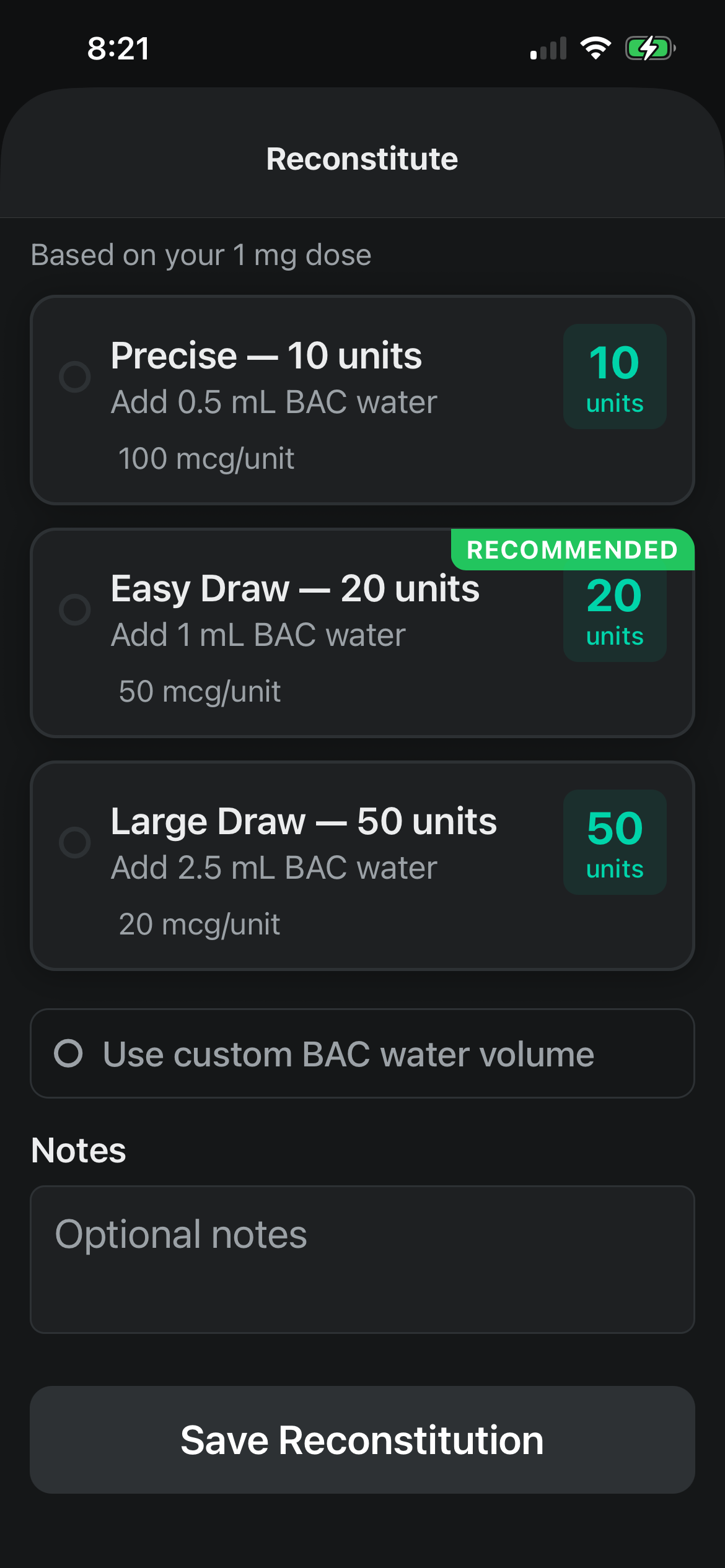
Protocol's reconstitution calculator — enter vial size, BAC water, and dose to get exact draw units
Every reconstitution requires: the peptide vial, bacteriostatic water (NOT sterile water for multi-dose use), a drawing syringe (1mL or 3mL for adding BAC water), your dosing syringe (U-100 insulin syringe, 28–31 gauge), and alcohol swabs. That is the complete list.
The critical detail: bacteriostatic water, not sterile water. Sterile water has no preservative. If you use sterile water, the reconstituted peptide should be used within 24 hours and discarded — the benzyl alcohol in BAC water is what prevents bacterial contamination across 20–40 draws over 30 days. BAC water is available from research chemical suppliers and some pharmacies.
Most people use 1mL insulin syringes (U-100) for both adding BAC water and dosing. This works if you only need to add 1mL. For 2mL+ additions, use a separate 3mL drawing syringe for the BAC water step, then your insulin syringe for dosing. Do not try to add 2mL through a 1mL syringe in two passes — it increases contamination risk.

Step by Step
Peptide vial, BAC water, drawing syringe, alcohol swabs, labeling materials. Work on a clean flat surface away from high-traffic areas.
Wipe the stopper of the peptide vial and the BAC water vial with a fresh alcohol swab. Allow 10–15 seconds to dry. Do not touch the center of the stopper after swabbing.
Insert the drawing syringe needle at an angle into the BAC water vial stopper. Slowly withdraw the calculated volume of BAC water. For 2mL standard: draw two full 1mL syringes or use one 3mL syringe.
Insert the needle into the peptide vial stopper. Tilt the vial so the needle tip touches the inner glass wall. Release the BAC water slowly so it runs down the side — not directly onto the powder. This prevents mechanical disruption of the peptide.
Gently rotate the vial in a circular motion until the powder dissolves. The solution should be clear and colorless. Most peptides dissolve in 30–90 seconds. Do not shake — shaking can cause foaming and mechanical peptide degradation.
Write the reconstitution date, BAC water volume, and calculated concentration on the vial. Store at 2–8°C (standard refrigerator). Reconstituted peptide in BAC water is stable for 28–30 days refrigerated.
Reference Data
These are the most common vial sizes and BAC water volumes, with the resulting concentrations and draw units for standard dose ranges.
| Vial Size | BAC Water | Concentration | 250mcg Dose | 500mcg Dose |
|---|---|---|---|---|
| 5mg | 2mL | 2,500 mcg/mL | 10 units | 20 units |
| 5mg | 4mL | 1,250 mcg/mL | 20 units | 40 units |
| 10mg | 2mL | 5,000 mcg/mL | 5 units | 10 units |
| 10mg | 4mL | 2,500 mcg/mL | 10 units | 20 units |
| 2mg | 1mL | 2,000 mcg/mL | 12.5 units | 25 units |
| 2mg | 2mL | 1,000 mcg/mL | 25 units | 50 units |
All draw unit calculations assume a U-100 insulin syringe (100 units = 1mL). Use the free calculator at reconstitution.health for any vial size or dose.
Common Questions